

Poster Flash Talks
Hawai‘i Summit Poster Flash Talks
The Poster Flash Talks provide attendees with an opportunity to discuss new research, programs, and other current issues with presenters who have created visual poster displays. Each presenter will provide a short 5 to 7-minute presentation followed by short Q&A.
Poster Flash Talk sessions will be on Monday, April 12, 2027, 3:35 PM - 4:45 PM.
Physical posters will be displayed at the Networking Reception on Monday, April 12, 4:45 PM to 6:30 PM.
Congratulations to our
23rd Hawaiʻi Poster Award Winners!
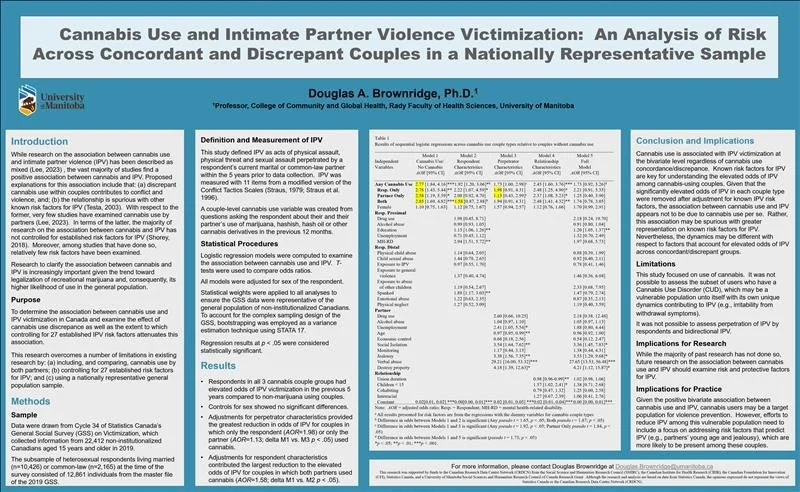
Poster #10 Cannabis Use and Intimate Partner Violence: An analysis of Risk Across Concordant and Discrepant Couples in a Nationally Representative Sample - Douglas Brownridge
Recipient of The Research Award: This award recognizes outstanding research concerning interpersonal violence or trauma that can lead to meaningful practice, policies, or advocacy. Ideally, this is an original study that is methodologically sound.
Abstract:
Research generally suggests that there is a positive association between cannabis use and intimate partner violence (IPV). The aim of this study was to determine the extent of the association between cannabis and IPV in Canada and examine the effect of risk factors derived from explanations for this phenomenon. Methods. A nationally representative sample of Canadians (n = 12,861) living in a marital or common-law union at the time of the study was analyzed using crosstabulations with chi square tests of significance and sequential logistic multiple regressions. Results. Cannabis use was associated with a three-fold increase in prevalence of IPV. Regardless of whether one (i.e., cannabis discrepant) or both (i.e., cannabis concordant) members of the couple used cannabis, and, among the former, regardless of which member of the couple was the cannabis user (i.e., the victim or the perpetrator), controlling for characteristics of the perpetrator fully accounted for the elevated odds of IPV among those in couples with cannabis use. Specifically, the results suggested that a greater tendency for partners in cannabis using couples to be of young age and to engage in dominating/controlling behaviors was responsible for their elevated risk of IPV. Conclusions. Regardless of cannabis use concordance/discrepance, the elevated odds of IPV for cannabis users can be explained by known IPV risk factors. This implies that interventions designed to address the elevated risk of IPV among the vulnerable population of cannabis consuming couples should include a focus on their greater tendency relative to non-cannabis users to be young and to engage in domination and control of their partner. Future research should include an interrogation of why cannabis users are more likely to possess these characteristics and the mechanisms through which they may contribute to the higher prevalence of IPV among these couples.
Poster #20 Developing a toolkit to address violence against fa'afafine in American Samoa! - Jaiyah Saelua
Recipient of The Intervention and Prevention Award: This award acknowledges significant contribution of original work involving an intervention or prevention program. Ideally it involves meaningful information on the intervention or prevention efforts for interpersonal violence or trauma.
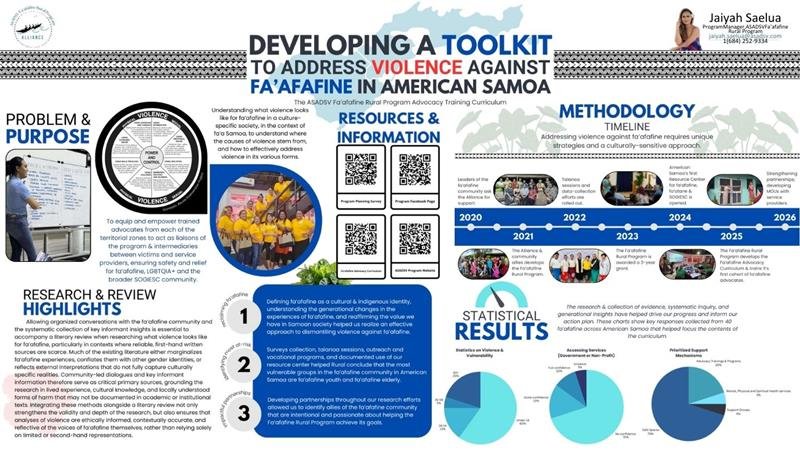
Abstract:
The development of the Fa’afafine Advocacy Curriculum marks a historic milestone as the first structured advocacy framework created specifically for fa’afafine in American Samoa. Rooted in Pacific cultural knowledge, community experience, and SOGIESC-affirming principles, the curriculum was designed to address the unique and complex safety needs of fa’afafine and the broader Pacific SOGIESC community. For decades, fa’afafine have navigated intersecting challenges—ranging from gender-based violence and social exclusion to limited access to safe reporting pathways and culturally competent support services. Yet, until recently, no locally grounded training resource existed to equip advocates, community leaders, and service providers with coherent approaches to safety, protection, and empowerment. This curriculum fills that gap by integrating: (1) culturally informed understandings of fa’afafine identities and roles; (2) regional SOGIESC rights frameworks; (3) trauma-informed and survivor-centered practices; and (4) practical advocacy tools tailored to Pacific community contexts. Its development was led by the Fa’afafine Rural Project in partnership with local leaders and regional experts, ensuring that the material reflects lived realities, community priorities, and Pacific models of care. In July, the Fa’afafine Rural Project successfully piloted the curriculum during a multi-day fa’afafine advocacy training held in Apia, Samoa. The training gathered fa’afafine participants and allied advocates from across the region, creating a safe and collaborative space for learning, skill-building, and collective strategizing. Participants reported strengthened confidence in applying advocacy tools, increased understanding of safety planning within cultural contexts, and a deepened sense of regional solidarity. The training also demonstrated the curriculum’s adaptability across Pacific settings and its value as a scalable model for culturally responsive SOGIESC advocacy. Overall, the Fa’afafine Advocacy Curriculum and its inaugural training represent a transformative step toward enhancing safety, visibility, and justice for fa’afafine and the wider Pacific SOGIESC community.