
Trainings Offered

FAP professionals from across Europe get together each year in Garmisch, Germany for training on best practices and new research related to abuse, trauma, risk assessment, and why the ways in which we connect matter. IVAT was honored to provide 4 full days of training to FAP professionals as part of the Domestic Abuse Victim Advocate (DAVA) program and the New Parent Support Program (NPSP).
Bring an IVAT Specialty Training to Your Workplace
IVAT is a comprehensive resource and training center addressing all aspects of violence, abuse and trauma across the lifespan. We strive to bridge the gaps between policy, practice and research to help improve current system-response by cultivating multidiscipline prevention and intervention strategies that promote trauma-informed, culturally sensitive, and gender-responsive prevention and interventions. For the past 25-years we have provided professionals and students access to our Summits and trainings to learn from leading experts in prevention, identification, investigation, and interventions for exploitation, abuse, and trauma.
We provide a list of opportunities for addressing interpersonal violence, child abuse, human trafficking, system-response and community engagement, professional burnout, and conflict resolution / de-escalation trainings. Fees for trainings vary depending on duration, and eligibility for receiving continuing education credits.

The Application of Trauma-Informed Practices in Social Work; Promoting Resiliency/Protective Factors in Abused Children & Adolescents: Current Research, Issues, and Intervention Techniques (National Taiwan University)
Check out some of our training testimonials below!
I am grateful to have come across IVAT and for the way you plunged right into this challenging request with joy and hope and dedication and wonderful human-centered stories and poetry and mindfulness and all that you brought to make it so meaningful. - Kathryn Hodges
Trainers were not only very informed, mindful, compassionate, experienced and gentle with presentation/materials; but also aware of the attendees and emotional aspects of this work, home visitation impact, parallel process its deeper level relationships. - Anonymous Attendee
I believe all professionals came out with a fresh eye, lots of information, research, and practical skills to continue advocating for our children and victims. Thank you so much! – Mental Health Professional
Clinical training and consultation can travel directly to you!

Mary Jo Barrett, MSW, is the Founder of Collaborative Change Consultation. Ms. Barrett has been working in the field of family violence since 1974 beginning with Parents Anonymous. She created the Collaborative Change Model, a contextual model of therapy used to transform the lives of those impacted by abuse and/or traumatic events. Her training and published works focus on the teaching of the Collaborative Change Model; Family Therapy and Interpersonal Violence; Adult Survivors of Abuse and Trauma; Complex Developmental Trauma and Compassion Fatigue. Ms. Barrett founded the Family Dialogue Project, a mediation program which strives to redefine relationships within families that have been impacted by allegations of abuse or differences that appear irreconcilable.
Would you like to bring an IVAT Training to your organization? Fill out the interest form below.
IVAT Webinar Trainings
Upcoming Webinars
Check back soon for info on upcoming webinars! View our current on demand offerings on our CE21 page.

Post-Graduate Certificate in Child Trauma and Protection
Stop the Silence® - A Department of IVAT, in partnership with The University of Applied Research and Development (UARD), accredited in the United Kingdom (UK), now offers a Post Graduate Certificate in Child Protection as a stand-alone program, or the credits can be used toward achieving a Master’s in the field. CEs are also offered. The Program is a unique opportunity to get important, fundamental information at one’s own pace provided by experts in the field of adverse childhood experiences (ACEs), for a fraction of the cost of other programs, and in as little as three months for the certificate and 12-24 months for the Master’s. The focus includes prevention, treatment, mitigation, and policy considerations regarding child sexual abuse, physical abuse, psychological abuse, and other traumatic events.
*Cohort 11 starts January 25th, 2027*
Recent Training and Events
Intimate Partner Violence & Housing: Barriers & Pathways to Safety
Presented by Vanessa Volz, JD, Sojourner House; Sarah May Lindsay, PhD, Trent University; Leila Wood, PhD, MSSW, UTHealth Houston; Lindsay Orchowski, PhD, The Warren Alpert Medical School of Brown University
‘Intimate Partner Violence & Housing: Barriers & Pathways to Safety', explores an intersectional approach to understanding housing as a means of safety and security for those who experience intimate partner violence (IPV). The Forum will examine how access to safe, stable and affordable housing can shape survivors' experiences of IPV and its aftermath.
Click here to view more information on IVAT's Bridging Research-to-Practice (R2P) initiative
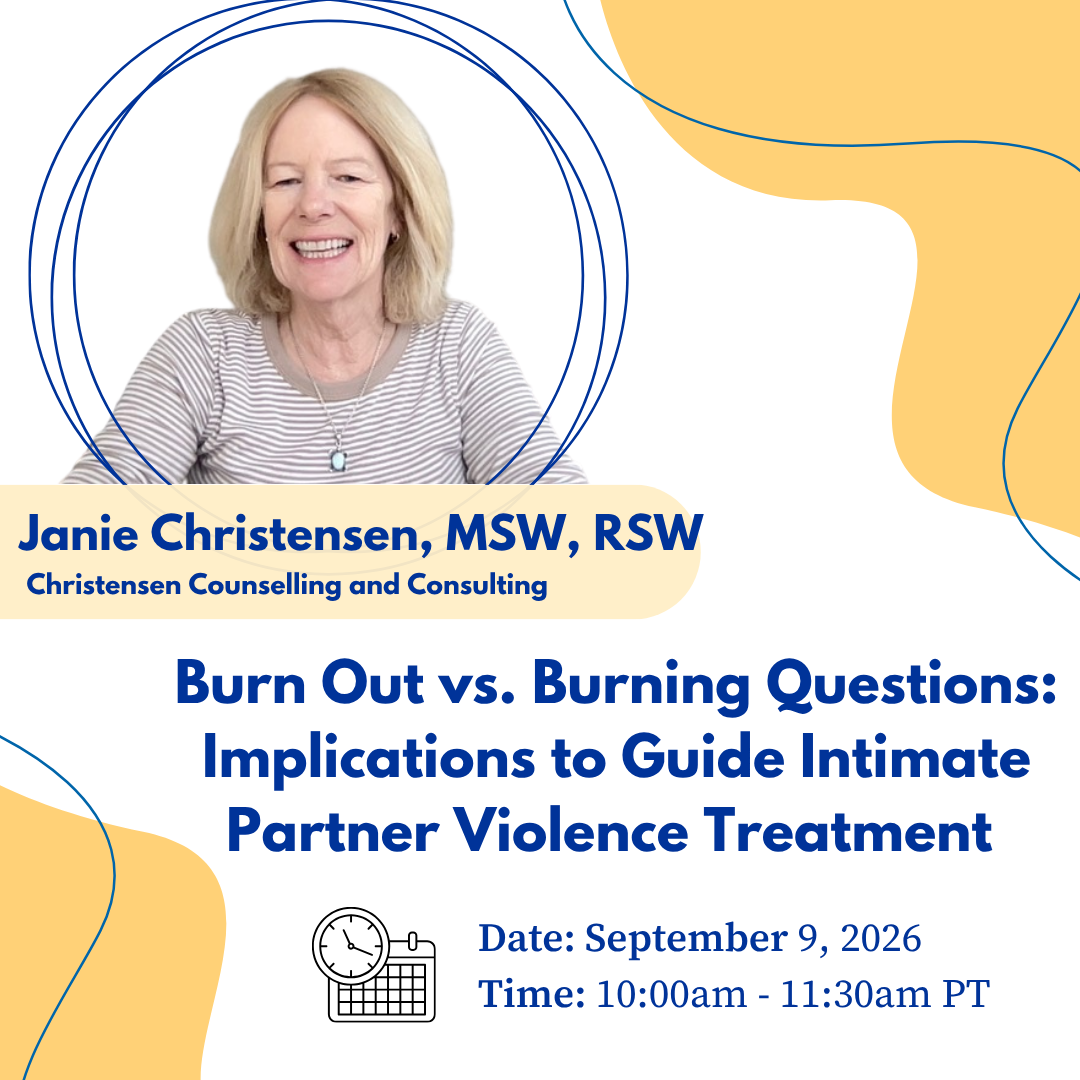
Burn Out vs. Burning Questions: Implications to Guide Intimate Partner Violence Treatment
Presented by Janie Christensen, MSW, RSW, Christensen Counselling and Consulting
Working in the field of domestic violence is an intense area of therapy or advocacy, that requires often hearing disturbing information, disseminating such information and the onus to demonstrate creating not just change, but safety. The ability to do this work, refreshed and effectively with healthy attitudes and compassion, requires professionals to be mindful of, in fact prepared for the inevitable signs of burn out or fatigue. To have healthy conversations that generate useful and practical remedies to that path is vital.

How Does Trafficking Happen and How to Respond? Grooming, Trauma Bonding, and Trauma-Informed Care
Presented by Ami Carpenter, PhD, University of San Diego
This training explains how individuals are recruited or groomed into trafficking situations, and debunks common myths – including that trafficking involves kidnapping and forcible confinement. We will take a deep dive into the “Romeo” or “boyfriend” trafficking strategy. A framework involving 6 stages of grooming into trafficking is introduced, which leads into a discussion of trauma-informed strategies for interacting with suspected or confirmed trafficking victims. At the end of the training, participants will be able to identify stages of grooming, differentiate strategies of trauma-informed care, and explain trauma bonding.

Working with Trauma in High-Conflict or Forensic Contexts
Presented by Shannon McHugh, PsyD, IVAT
This advanced training examines the complexities of working with trauma in high-conflict and forensic contexts, with the purpose of enhancing clinicians’ ability to conduct accurate, objective, and defensible evaluations. Key topics include the impact of ongoing litigation on symptom presentation, differentiating trauma-related responses from response bias or secondary gain, and navigating competing narratives while maintaining a trauma-informed framework. The presentation integrates current research and best practices in forensic assessment, emphasizing ethical considerations, limits of clinical inference, and strategies for managing ambiguity in high-stakes cases.

Making the Record for Appeal
Presented by Joan Meier, JD, National Family Violence Law Center
This webinar will describe the value of appeals while spelling out the steps litigators must take in order to preserve appeal as an option. It will describe the critical importance of making a record for appeal, spelling out the procedural requirements, some strategies for how to meet them, and how to identify in advance the types of issues which may be worthy for appeal. It will also help attendees understand the need for courageous advocacy in the face of occasional judicial resistance to lawyers’ efforts to ensure the record for appeal is adequately developed. It will provide examples of appeal-worthy cases and will also invite discussion of attendees’ experiences and questions

Violence, Abuse, and the Constitution: Why Achieving Basic Legal Equality for Women Will Save Lives
Presented by Wendy Murphy, JD, New England Law
This webinar will address the causal relationship between high rates of woman and child abuse, and women's inequality under the United States Constitution. Studies have long shown disparate treatment of women and children in their capacities as victims of violence and abuse. From bias against mothers in family court, to the disproportionate failure of police and prosecutors to file charges in cases where women and children are victimized, the data is clear that women and children suffer unequal treatment and systemic injustice in all legal contexts.

Moral Injury Explained: How It Differs from PTSD and Why It’s Often Missed
Presented by Jessica Mueller-Coyne, PsyD; Kiyana Dailey, MA, LMFT; Andrea Anthony, MS
Moral injury occurs when individuals perpetrate, witness, or fail to prevent actions that violate their deeply held moral beliefs. It causes profound psychological, emotional, and spiritual distress. Moral injury differs from PTSD as its focus is on shame and loss of trust, rather than fear-based trauma. It’s essential for people to learn about moral injury because it helps them recognize a form of distress that is often misdiagnosed or overlooked as depression or PTSD. Understanding moral injury enables clinicians to more accurately identify the underlying guilt, shame, betrayal, and loss of meaning that may contribute to clients’ presentations yet remain undetected through standard assessments.

Criminal or Victim? Understanding the Evolution of Domestic Minor Sex Trafficking and the Unjust Criminalization of Trafficked Youth
Presented by Mikayla Simeral, MSW, MA, Shared Hope International
This webinar examines why trafficked youth in the United States have historically been misidentified and criminalized rather than recognized as victims. The session traces the evolution of domestic minor sex trafficking and highlights how trauma responses, systemic bias, and gaps in services contribute to these harmful outcomes. Drawing from both direct advocacy experience and national-level training and policy work, Mikayla will offer practical strategies for early identification, trauma-informed engagement, and survivor-centered intervention. Participants will leave with a clearer understanding of how misidentification occurs—and how to help shift responses that protect, support, and dignify exploited youth.

Domestic Violence in Military Families: Trauma-Informed Approach and Systemic Responses
Presented by Jessica Mueller-Coyne, PsyD; Kiyana Dailey, MA, LMFT; Andrea Anthony, MS
Domestic violence in military families presents unique clinical, cultural, and systemic challenges for providers, advocates, and legal professionals. This webinar examines the intersection of trauma, military culture, deployment-related stress, and systemic responses to family violence. Participants will explore risk factors such as PTSD, substance use, and power dynamics. We will also address barriers to reporting and accessing services. Evidence-based and trauma-informed strategies will be emphasized, with an added focus on culturally responsive care for diverse military families.

Best Practices in Telehealth Counseling
Presented by Lauren Bruaski, Psy.D., LMFT.
An engaging and informative presentation with Dr. Lauren Bruaski, Executive Clinical Director of the USD Tele-Mental Health Training Clinic, as she explores the evolving landscape of telehealth counseling. A Licensed Marriage and Family Therapist and AAMFT/BBS-approved clinical supervisor, Dr. Bruaski will share practical guidance on delivering effective, ethical, and client-centered care in a virtual setting. This session will cover key topics including legal and ethical considerations, technology and platform selection, creating a comfortable virtual environment, adapting clinical interventions for telehealth, and addressing the needs of diverse and underserved populations.

Treatment Approaches for Violent Female Offenders
Presented by Jessica Mueller Coyne, Psy.D.
Female violence remains challenging for society, correctional settings, and clinicians to manage, assess risk, and develop treatment pathways. Often, treatments that are offered to women are based on research on male samples. Further, research on treatment and assessment of violent female offenders remains minimal. This presentation aims to provide an overview of best practice research, and reviews treatment considerations and recommendations for trauma-informed practice in working with violent female offenders.

Using Motivation for Abuse to Guide Treatment
Presented by Janie Christensen, MSW, RSW
How many clients go through rigorous domestic violence or anger management counselling and still are abusive, or are abusive in different ways, even when they have the tools? It is valuable and necessary obviously to teach those valuable skills in therapy. Peel back the layers however, and it is imperative to go so much deeper with some very simple questions that uncover the ‘why’ of abuse, in each circumstance. We need to better unpack and examine individual choices to be abusive, very little of which is physical, but that emotional and verbal violence that so impairs and damages, and in looking at the ‘why,’ better understand individual choices. In doing so, we may tailor treatment to the many different kinds of abuse, and personalities, rather than using one blanket approach which makes that perhaps egregious assumption that all violence is based on lack of skills and not a desire to hurt.

Ensuring We Get Cases Right: Identifying Mistakes That Lead to Child Abuse Being Ruled Out
Presented by Paul Griffin, JD
Proving child sexual abuse is challenging due to the lack of physical evidence, making a child’s disclosures the most compelling evidence. However, these disclosures are often dismissed for reasons unsupported by modern science, such as inconsistencies in the child's statements or claims of coaching. Additionally, a child may provide details that appear to contradict the timeline, like the accused having an alibi, or include fantastical elements, such as being rescued by a dog. A child may also later recant their statement. These issues can lead Child Protective Services (CPS) investigators to dismiss the abuse, which in turn affects law enforcement decisions and custody rulings.

Treating Intrafamilial Sexual Abuse: How Are We Helping Our Clients Heal?
Presented by Mary Jo Barrett, MSW
Have we helped to keep intrafamilial sexual abuse a secret by lumping it under the name of Trauma? Have we assisted in sweeping this form of sexual abuse under the rug like so many of our clients and their family members do? This will workshop will bring the fact that a vast number of our trauma clients are victims of intrafamilial sexual abuse and their treatment must be enlightened about the nuances of this complex developmental trauma. In this workshop, we will be exploring interventions for the crisis of discovery and disclosure, understanding of how being related to a perpetrator impacts the therapeutic relationship, and understanding the dynamics of sibling sexual abuse.

Understanding and Supporting Neurodivergent Clients
Presented by Zahava “Zee” Zaidoff
The world is created for those with neurotypical brains. Neurodivergent individuals struggle to make sense of, and fit into this world. Almost all of the treatment that exists for neurodivergent people is about teaching them how to mask their behaviors to make others more comfortable and to “fit better” into the world around them. That is unfair. That is harmful. That is painful. That is the opposite of healing. When providers can understand even the basics of what it means to be neurodivergent, positive patient outcomes can increase dramatically. We owe it to those we serve to help them navigate their neurotype, so they too can be successful; on their own terms.

Novel Approaches to Overcoming Reproductive Trauma
Presented by Abigail Burd, LCSW, PMH-C
Reproductive mental health expert, Abigail (Abby) Burd, LCSW, PMH-C,, shares best-practices as well as novel and creative approaches to helping overcome perinatal trauma. Learn via real life case studies and leave empowered to give healing and hope.

Treatment of Male & Female Domestic Violence Offenders: Issues, Controversies, Approaches, and Practical Techniques
Presented by Robert Geffner, PhD, ABPP, ABN
This workshop focuses on some of the controversies and current issues in the field of spouse/partner abuse, including approaches and techniques that have been utilized for those accused or confirmed of abusing their partner, typologies of male and female offenders, recent research concerning the effectiveness of intervention, and the types of treatment or other interventions that might be appropriate. This workshop discusses and demonstrates intervention approaches and techniques for both male and female offenders, including an abuse-specific couples approach.

After Abuse: The Case for Individual and Institutional Restorative Justice
Presented by Alissa Ackerman, PhD & Guila Benchimol, PhD
Restorative Justice is a survivor-centered approach to healing that honors the humanity of all parties involved. It offers unique and creative pathways for addressing the needs expressed by those impacted by harm. Sometimes those pathways involve direct interaction with the initial harm doer, while other times it includes those responsible for secondary or institutional harm. This workshop will explore the roots and fundamentals of restorative justice. It will then cover the use of restorative justice in individual and institutional cases.

LGB&T Cultural Humility - Knowing our Place
Presented by Kunane Dreier & Maddalynn Sesepasara
LGB&T Cultural Humility training is designed to increase knowledge and skills to effectively interact with LGB&T people, as well as support and provide affirming care and support. This training integrates the unique viewpoints of local and Hawaiian culture as related to māhū. Utilizing the unique viewpoints of our Hawaiian and local cultures, we aim to increase humility and capacity for understanding when engaging with our most vulnerable populations.

Stopping Violence Through Understanding Failure and Rejection
Presented by Janie Christensen, MSW, RSW
This training will delve into the intricate connection between substance use and sex trafficking in Hawai'i. Gain valuable insights into the vulnerabilities that underlie substance abuse and how addiction can be wielded as a tool of exploitation. Explore the current landscape of healing and discover pathways to enhance the recovery journey for survivors in the future.

Intersections of Substance Use and Sex Trafficking
Presented by Ashley Maha’a
This training will delve into the intricate connection between substance use and sex trafficking in Hawai'i. Gain valuable insights into the vulnerabilities that underlie substance abuse and how addiction can be wielded as a tool of exploitation. Explore the current landscape of healing and discover pathways to enhance the recovery journey for survivors in the future.

SAFeR: A Systematic Approach to Addressing IPV in Child Custody and Parenting Time Cases
Presented by Tracy Shoberg, JD
This training will introduce legal practitioners to a structured approach to decision-making in domestic violence-related custody cases that centralizes the experience of battered parents and their children. The training will also acquaint participants with a suite of tools designed to enhance screening, assessment, and informed decision making in domestic violence related child custody matters.

Custody Outcomes in Cases Involving Abuse and Alienation Allegations: What Do the Data Show?
Presented by Joan Meier, JD
This webinar is the the first study to ever assess custody case outcomes across the U.S., the 2019 Custody Outcomes in Cases Involving Abuse and Alienation Allegations study was federally funded by the National Institute of Justice. Findings regarding courts' skepticism of abuse allegations by mothers, the power of alienation crossclaims, and gender bias will be reported.

Unmasking Abuse: Identifying Psychological Defenses That Put Families at Risk
Presented by Robin Lynch, PhD
This webinar is designed for identifying the dynamics that lead to abuse is central to effective domestic violence prevention. Intervention is difficult as abuse is often difficult to discern, including to the victims, and to measure. This presentation introduces the notion of the “narcissistic affect dysregulated” individual who projects their emptiness and anger on others to self-regulate and, in doing so, creates abusive relationships.

Neurobiology of Trauma
Presented by Dr. Robert Geffner, PhD, APN, ABPP
This workshop is designed for a range of professionals who work with survivors of trauma and will cover the different areas of the brain that are affected by traumatic and stressful situations. This workshop will describe how adverse childhood experiences can disrupt neurobiological development that can affect functioning throughout the lifespan.

Collaborative Recovery: Using Experiential & Person-Centered Approaches for Survivors of Sexual Assault and Institutional Betrayal
Presented by Lori R. Daniels, Ph.D., LCSW
This workshop will discuss various integrative, person-centered, and experiential psychotherapy techniques, provide assessment tools, and ways to build rapport while contracting for treatment. Due to the collaborative nature of the counseling work based on a survivor’s level of information for interventions, a person-centered, experiential approach for IBSA recovery may also be useful for clients of diverse backgrounds.

Invisible Epidemic: Strangulation, Traumatic Brain Injury and Domestic Violence
Presented by Rachel Ramirez, MSW, LISW-S, RA
When most people hear "concussion" they think about sports or the NFL. But what about brain injuries caused by domestic violence? Come to learn about the invisible epidemic of brain injury caused by violence--an emerging issue featured recently on NPR's OnPoint and in the New York Times Magazine.

Understanding Coercive Control and How it Harms Children
Presented by Dr. Emma Katz, PhD
This presentation explores survivor mothers’ and children’s experience of coercive control, both before and after the survivor mother has separated from the abusing father. Showing how coercive control harms children, it will enable delegates to push beyond the view of children as ‘witnesses’ or as ‘exposed’ to abuse. By understanding children’s perspectives, we can see them as co-victims and co-survivors.

Bringing Caregivers and Children Together: An Overview of PC-Care and Its Application in Hawai`i
Presented by Alexandria King, PsyD
Developed in 2016, Parent-Child Care (PC-CARE) is an abbreviated form of Parent Child Interaction Therapy. This 7 session dyadic treatment program was designed for families that are interested in improving caregiver-child relationships and are willing to learn new child behavior management strategies. In this webinar, Dr. Alex King will share why PC-CARE was developed and some of the outcomes from research on this new intervention. Additionally, participants will learn about the core components of the PC-CARE model including experiential practice with the skills of PC-CARE.

The Link Between Grief and Trauma: A Tailored Treatment
Presented by Blythe Landry, MEd, LCSW
When we work in trauma for years on end, the inevitability of vicarious trauma and moral injury are ever present. As seasoned trauma professionals, we often have basic trainings around vicarious/secondary trauma, but we don't often go deeper to discern our own very personal reactions and how this can create a deep grief response that is hard for those who are not in our field to understand. Left unaddressed, this grief reaction can adversely impact our relationships, our professional offerings, and our own mental health. This training will be for intermediate to advanced practitioners seeking a more in-depth and interactive approach to both discussing and responding to vicarious trauma and all that it causes in our lives.

It’s Alienation, Clearly - Or Is It?
Presented by Madelyn Simring Milchman, PhD.
This webinar addresses evidence needed to assess causes of parent rejection in custody cases. It identifies problems that are unique to assessing alienation and differentiating it from child sexual abuse, child maltreatment, and bad parenting. It supports improved evaluations, investigations, direct and cross-examinations, and judicial decisions.

Walking the Delicate Balance: Helping Adult Survivors with their Future Relationships with their Families
Presented by Mary Jo Barrett, MSW
Adult Survivors of childhood abuse, neglect, and trauma often struggle with how to have a relationship with family members that contributed to their experience. Therapists want to understand how to clinically manage the adult relationships of their clients. There is no one solution. This workshop will provide clinicians with some therapeutic concepts and interventions to help their clients navigate difficult family relationships.